
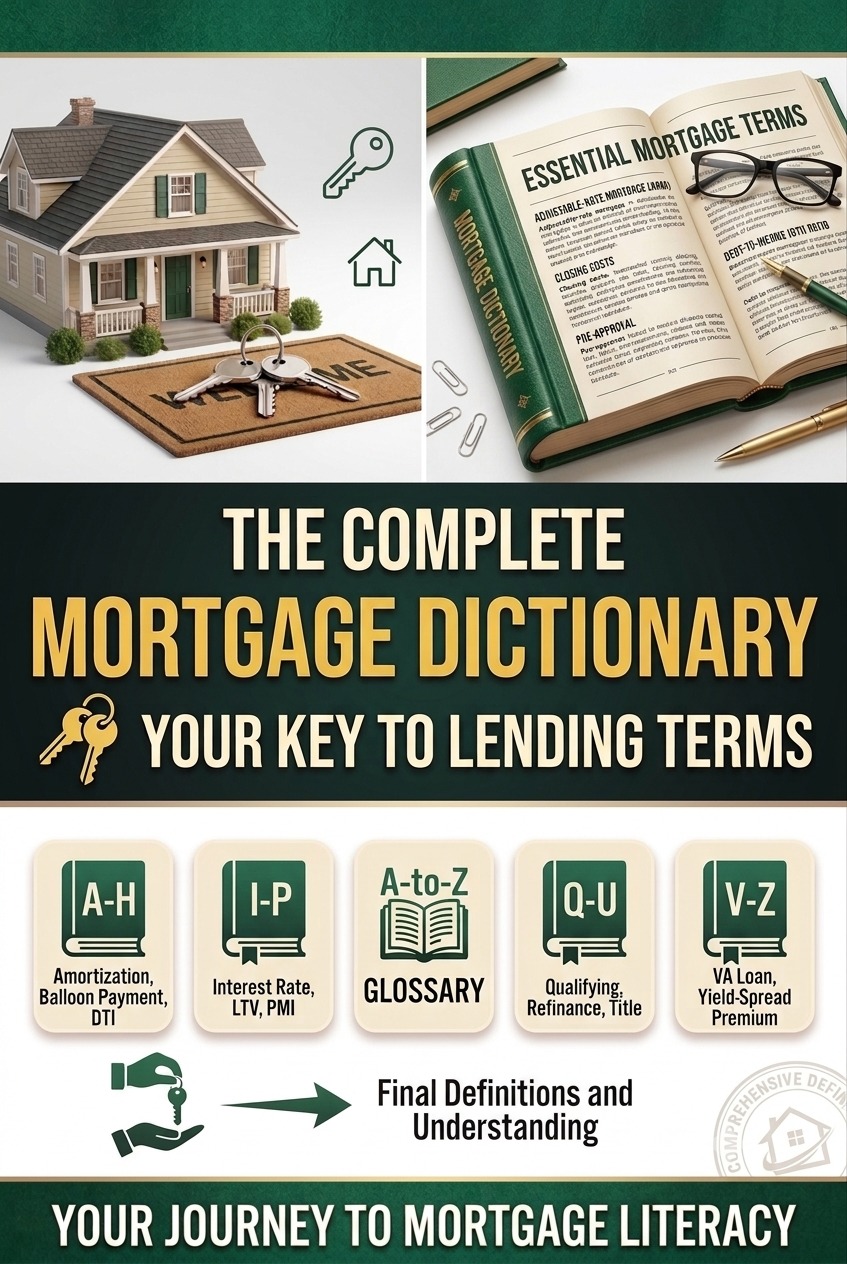
The Complete Mortgage Dictionary
Plain-English Mortgage Terms Every Homebuyer Should Know
Buying a home comes with a language all its own. If you’ve ever wondered what a lender, Realtor, or title company meant by a particular mortgage term, you’re not alone.
This Mortgage Dictionary was created to explain common mortgage and real estate terms in simple, everyday language. My goal is to help you make informed decisions with confidence throughout your homeownership journey.
Education creates confidence. Confidence creates better decisions. Better decisions build stronger families.
A
Amortization
The process of paying off a mortgage over time through scheduled monthly payments. Early in the loan, a larger portion of your payment goes toward interest. Over time, more of each payment is applied to the principal balance.
Annual Percentage Rate (APR)
The yearly cost of borrowing money, including the interest rate and certain lender fees. APR helps compare loan options, but it is different from your actual interest rate.
Appraisal
An independent estimate of a property’s market value performed by a licensed appraiser. Lenders use the appraisal to help ensure the home’s value supports the loan amount.
Appraised Value
The value assigned to a property by an appraiser after evaluating the home’s condition, location, size, and comparable sales.
Assets
Money or property you own that has financial value, such as checking accounts, savings accounts, retirement funds, investments, or other real estate.
Automated Underwriting System (AUS)
Technology used by lenders to evaluate a mortgage application based on established lending guidelines. Common systems include Fannie Mae’s Desktop Underwriter (DU) and Freddie Mac’s Loan Product Advisor (LPA).
B
Bank Statement Loan
A mortgage designed primarily for self-employed borrowers who qualify using bank deposits instead of traditional tax return income.
Buydown
A financing strategy that temporarily or permanently lowers your mortgage interest rate, often paid for by the seller, builder, or lender.
Buyer Representation Agreement
A contract between a homebuyer and a real estate agent outlining how the agent will represent the buyer during the home purchase process.
C
Cash to Close
The total amount of money you must bring to closing after accounting for your down payment, closing costs, credits, and deposits already paid.
Clear to Close (CTC)
The lender’s authorization that all underwriting conditions have been satisfied and the loan is approved to move to closing.
Closing Costs
Fees and expenses associated with purchasing or refinancing a home, including lender fees, title fees, escrow charges, prepaid taxes, and insurance.
Closing Disclosure (CD)
A document provided before closing that summarizes your final loan terms, monthly payment, closing costs, and the cash needed to complete the transaction.
Conditional Approval (Credit Decision)
An underwriter’s approval stating that your loan qualifies provided all remaining conditions are satisfied before closing.
Conventional Loan
A mortgage that is not insured or guaranteed by a government agency. Conventional loans generally follow guidelines established by Fannie Mae or Freddie Mac.
D
Debt-to-Income Ratio (DTI)
The percentage of your gross monthly income used to pay monthly debt obligations. Lenders use DTI to help determine how much you can afford to borrow.
Discount Points
Optional upfront fees paid to reduce your mortgage interest rate. One discount point typically equals 1% of the loan amount.
Down Payment
The portion of the home’s purchase price you pay upfront rather than finance through the mortgage.
DSCR Loan
Debt Service Coverage Ratio (DSCR) loans are designed for real estate investors and qualify primarily based on the property’s rental income rather than the borrower’s personal income.
Desktop Underwriter (DU)
Fannie Mae’s Automated Underwriting System used to evaluate mortgage applications.
E
Earnest Money Deposit
A good-faith deposit made with an offer to purchase a home. It demonstrates the buyer’s commitment to the transaction and is typically credited toward closing.
Escrow
A neutral third party that holds funds and documents while the home purchase is completed.
Escrow Account
An account maintained by the loan servicer to collect property taxes and homeowners insurance as part of your monthly mortgage payment.
Equity
The difference between your home’s market value and the amount you still owe on your mortgage.
F
FHA Loan
A mortgage insured by the Federal Housing Administration that allows lower down payments and more flexible credit guidelines for qualified borrowers.
Fixed-Rate Mortgage
A mortgage with an interest rate that remains the same throughout the life of the loan.
FundingThe stage when the lender disburses the mortgage funds after all loan documents have been signed and approved.
G
Gift Funds
Money provided by an eligible family member or approved donor to help with a down payment or closing costs. Documentation requirements apply.
Gross Monthly Income
Your total income before taxes and other deductions. Lenders use this figure when calculating your debt-to-income ratio.
H
HELOC
A Home Equity Line of Credit allows homeowners to borrow against the equity in their home through a revolving line of credit.
Homeowners Insurance
Insurance that protects your home against covered losses such as fire, theft, or certain natural disasters. Most lenders require homeowners insurance before closing.
I
Interest Rate
The percentage charged by the lender for borrowing money.
Investment Property
A property purchased primarily to generate rental income or long-term appreciation rather than serve as your primary residence.
J
Jumbo Loan
A mortgage that exceeds the conforming loan limits established by the Federal Housing Finance Agency and typically has additional qualifying requirements.
L
Loan Estimate (LE)
A standardized document provided early in the mortgage process outlining estimated loan terms, interest rate, monthly payment, and closing costs.
Loan-to-Value Ratio (LTV)
The loan amount divided by the property’s appraised value or purchase price, expressed as a percentage.
Loan Product Advisor (LPA)
Freddie Mac’s Automated Underwriting System used to evaluate mortgage applications.
M
Mortgage
A loan used to finance the purchase or refinance of real estate.
Mortgage Insurance (MI)
Insurance that protects the lender if the borrower defaults. Depending on the loan program, mortgage insurance may be required with lower down payments.
P
PITI
An acronym for Principal, Interest, Taxes, and Insurance—the four primary components of a monthly mortgage payment.
Pre-Approval
A review performed by your Mortgage Advisor using your financial information and, in many cases, an Automated Underwriting System to estimate the loan amount you may qualify for.
Pre-Qualification
An initial estimate of borrowing power based primarily on information provided by the borrower before full documentation is reviewed.
Principal
The original amount borrowed, excluding interest.
Private Mortgage Insurance (PMI)
Mortgage insurance typically required on certain conventional loans when the down payment is less than 20%.
R
Rate Lock
An agreement that locks your mortgage interest rate for a specified period while your loan is processed.
Recording
The official filing of your property’s ownership documents with the county. Once recorded, the transaction is complete.
Refinance
Replacing an existing mortgage with a new loan, often to obtain a different interest rate, payment, or loan term.
Reserves
Savings remaining after closing that demonstrate your ability to continue making mortgage payments if unexpected financial challenges arise.
U
Underwriter
A mortgage professional responsible for reviewing the loan file and determining whether it meets the lender’s guidelines.
Underwriting
The process of evaluating a borrower’s financial profile, documentation, property, and loan eligibility before final approval.
USDA Loan
A government-backed mortgage program for eligible rural properties that may offer 100% financing to qualified borrowers.
V
VA Loan
A mortgage benefit available to eligible veterans, active-duty service members, and certain surviving spouses. Qualified borrowers may be eligible for no down payment and no monthly mortgage insurance.
W
Wire Transfer
An electronic transfer of funds commonly used to deliver the money required for closing.
Continue Learning
This Mortgage Dictionary is part of the Louay Yousif Homeownership Resource Center. Throughout the website you’ll find detailed guides covering first-time homebuyers, VA loans, FHA loans, refinancing, investors, property taxes, mortgage planning, and many other topics to help you make informed financial decisions.
Comments open